
Are Turkish Towels Absorbent? What the Flat Weave Does
A Turkish towel is thin, and that is the point. What the flat weave does with water, how it differs from terry pile, and how our jacquard towels and waffle throws are actually made — 100% organic cotton, woven in Turkey, the pattern woven in rather than printed.

Are Turkish towels absorbent? Yes. On our Turkish jacquard towels the smooth, flat weave makes the cloth highly absorbent yet compact: 100 × 200 cm of 100% organic cotton, woven in Turkey, soft to the touch and quick to dry after use. A flat weave and a terry pile do not handle water the same way, and the difference is where the thinness comes from.
Are Turkish towels absorbent? How the flat weave takes up water
Two separate things get bundled together in that question. One is capacity — how much water a cloth can hold at once. The other is what happens next, which is how quickly the cloth gives that water back to the air. Terry answers the first by building a reservoir. A flat weave answers both by spreading.
The fibre does most of the work, and in both cases the fibre is cotton. Cotton is hydrophilic: it draws water in and swells as it goes. Nothing about the weave changes that appetite. What the weave changes is where the water goes once the cotton has taken it.
Terry stands loops of yarn off a woven ground, and those loops are a store. Press terry to wet skin and water is pulled up into the pile and held there, which is why a terry towel feels heavy long before it looks wet. A flat weave has no pile to fill. Water enters the yarn where the cloth touches you, travels along that yarn, and moves sideways through the weave into parts of the cloth that are not touching you yet. It is spread thin rather than stored deep. On our jacquard towels that is 100 × 200 cm of organic cotton for the water to travel across, which is how one cloth manages to be highly absorbent and still compact.
In practice you dry a little differently. With terry you press one patch of cloth against yourself and wait for it to soak. With a flat weave you draw the cloth across you and keep moving through it, using its length rather than one corner of it. It is a small adjustment, and it is the whole of the technique.

Turkish towel vs regular towel: flat weave against terry pile
Flat-woven Turkish towels are traditionally called peshtemals. Terry is the looped construction most bath towels use. Neither is a badly made cloth — they are built differently, and they behave according to how they are built.
The two constructions solve the same problem from opposite directions. A towel works by putting fibre surface against water. Terry buys that surface by standing yarn up off the ground weave, so the cloth thickens and most of its working area sits in the third dimension. A flat weave has only the plane of the cloth to work with, so it buys the equivalent surface by being long, and by letting water travel along the yarn to reach cloth that is still dry.
The rest follows from that. A pile holds air as well as water, which is what makes terry feel warm and deep in the hand, and what keeps the base of the pile damp after the tips have dried. A flat cloth has almost all of its fibre exposed to the air, so it gives water back readily. Wet, a pile is heavier to carry. Folded, it takes more room. Neither is a flaw. Both are the price of the plushness, and whether that price is worth paying depends on whether the towel stays on a rail or goes in a bag.
| Point of comparison | Our flat-woven Turkish towels | Terry towel |
|---|---|---|
| Structure | Flat-woven cloth with no pile; the jacquard design is woven into the fabric rather than printed on it | Loops of pile standing off a woven ground |
| Surface in the hand | Smooth, with subtle texture from the weave itself | Raised and plush |
| Where the water goes | Along the yarn and outward through the cloth | Into the pile, where it is held |
| Bulk | Comfort without weight; compact once folded | The pile adds thickness, so it takes more room |
| Fibre | 100% organic cotton, woven in Turkey, free from synthetics | Varies by maker |
| Size | 100 × 200 cm on the jacquard towels | Varies by maker |
| What it is made for | Travel, beach days and everyday bath rituals | Depth of pile against the skin |
Why is my Turkish towel not absorbent?
When a cotton cloth starts shedding water rather than taking it up, the weave is not what changed; a weave cannot stop being a weave. Ours are free from synthetics and harsh finishes, so nothing was built into the fabric to stand between the fibre and the water. Something has reached the fibre since, and the list of candidates is short.
What follows is general practice for cotton cloth, not an instruction for your particular piece. For that, check the care label on your piece — it is the only authority on temperatures and cycles.
- A softening film. Fabric softeners and tumble-dryer sheets work by leaving a thin lubricating layer on the fibre. Anything that makes cotton feel slippery also sits between the cotton and the water. It is the first thing to rule out.
- Residue. Whatever is not rinsed out of a cloth stays in the space the water needs to travel through. A flat weave has less cloth to hide it in than a pile fabric does.
- Hard water. Mineral deposits build up inside the yarn over time and leave woven cotton feeling board-like.
- A crowded drum. A large cloth packed into a full machine has less room to move and less room to rinse. It comes out carrying what it went in with.
None of that is particular to Turkish weaving. It applies to any cotton cloth whose job is to move water, and it is worth working through before you decide the towel is at fault.
How to soften a Turkish towel and keep it that way
Softness and absorbency are the same project, because both depend on the cotton being left uncoated. Ours are made without synthetics or harsh finishes, finished with gentle, low-impact dyes, and they only get softer with time. Most of the work is a matter of not undoing that.
Again, this is general practice with woven cotton rather than a set of steps for your towel. Check the care label before you change how you wash it.
- Leave the softener and the tumble-dryer sheets out of it. The film is the point of those products, and the film is the problem.
- Give the cloth room. Two metres of towel needs space to move if it is going to rinse properly.
- Let it move as it dries. Woven cotton that dries perfectly still tends to set crisp; a firm shake before it goes on the line puts the drape back into it.
- If the care label on your piece allows tumble drying, a short tumble does the same work as the shake, flexing the yarns rather than letting them set.
- Skip the iron. Pressing flattens the surface and closes the texture the weave is there to create.
Jacquard towel or waffle throw: which Turkish weave for which job
Two of the Turkish weaves we sell look like near neighbours, and only one of the two is sold as a towel. That distinction matters more here than the peshtemal-versus-terry question does.
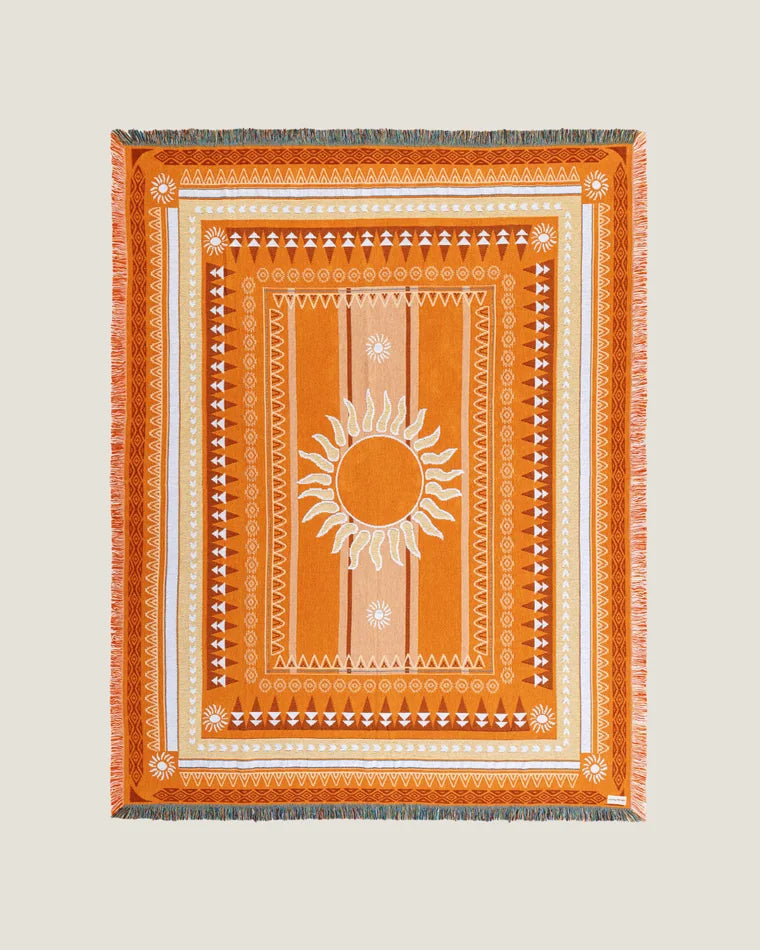
The jacquard towels are the ones made for drying. Woven in Turkey from 100% organic cotton in small batches, 100 × 200 cm, with the design crafted directly into the fabric rather than printed on it. The result is subtle texture, lasting colour and a pattern that wears beautifully over time. They are soft to the touch and naturally breathable, they offer comfort without weight, and they dry quickly after use. The jacquard towel in Coastal Sage and the towel in Terracotta Sun are both woven to that specification.
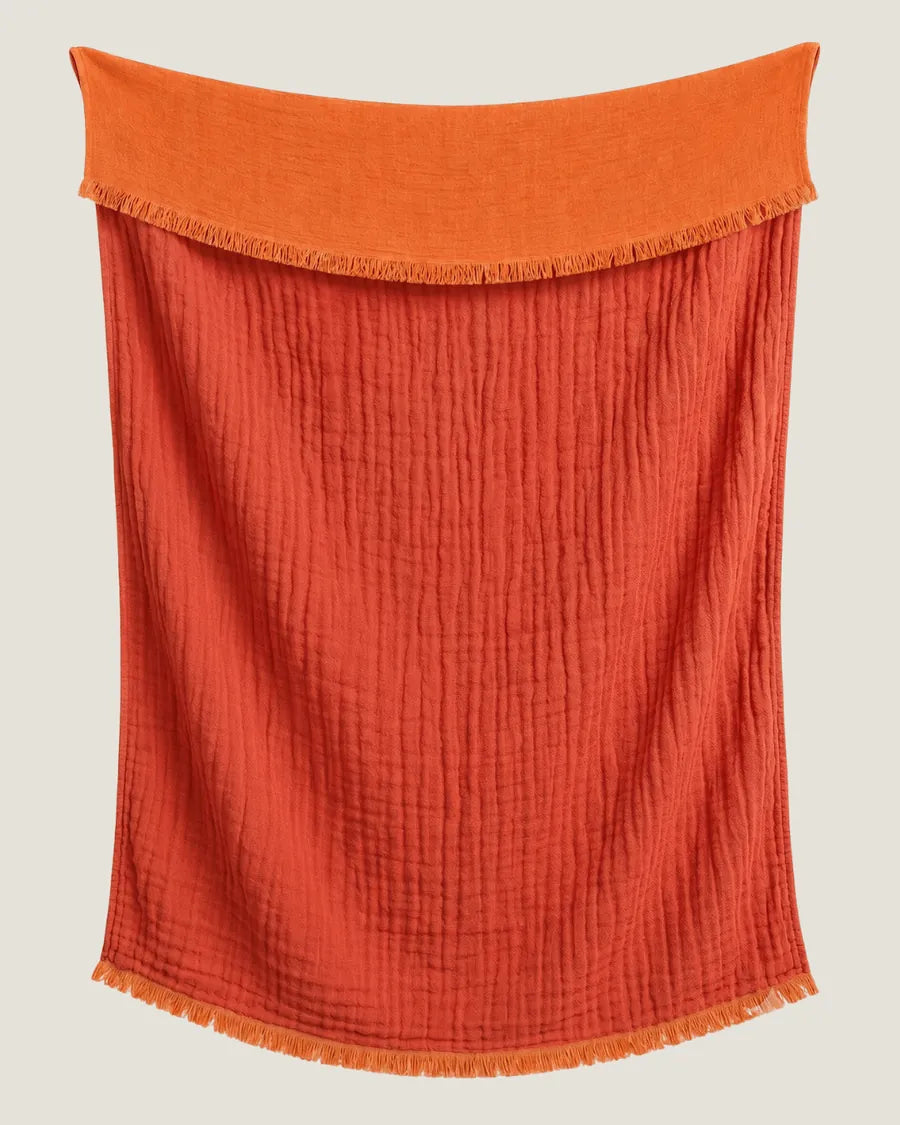
The waffle pieces are a different proposition, and it is worth being plain about it. The oversize waffle throw in Sea Mist is 150 × 180 cm, woven in Turkey from 100% organic cotton, with a dimensional waffle weave that gives warmth without weight. We sell it as a throw — an everyday layer for the bed, the sofa or a cooler evening — not as a towel.
| Specification | Organic Cotton Turkish Jacquard Towel | Organic Cotton Turkish Waffle Oversize Throw |
|---|---|---|
| Sold as | A towel | A throw |
| Size | 100 × 200 cm (39" × 78") | 150 × 180 cm (59" × 71") |
| Fibre | 100% organic cotton, woven in Turkey | 100% organic cotton, woven in Turkey |
| Weave | Smooth flat weave, jacquard design woven in rather than printed | Dimensional waffle weave |
| What it is for | Travel, beach days, everyday bath rituals | An everyday layer for the bed, sofa or cooler evenings |
| Finish | Free from synthetics; gentle, low-impact dyes | Made without synthetics or harsh finishes; soft, sun-washed tones |
| The short version | Highly absorbent yet compact, and quick to dry | Warmth without weight, year round |

Are Turkish towels worth it?
It depends on what you want a towel to do.
A flat weave earns its place if you want one cloth that moves between the bathroom, the car and the sand without taking a shelf to itself. Compact and lightweight, quick to dry after use, and made for travel, beach days and everyday bath rituals — that is what the construction is for. It earns its place again if you care what the cloth is made of: 100% organic cotton, woven in Turkey in small batches, free from synthetics, finished with gentle, low-impact dyes, and patterned by the loom rather than by a print, so the design wears with the cloth instead of off it.
It is not the right buy if what you love is sinking into something deep and plush after a long bath. A flat weave has no pile, and it will not grow one. That is a structural fact rather than a fault, and it is better known before you buy than after.
Sand is the other structural argument. A pile fabric offers loops for sand to settle between. A flat weave does not, because it does not have the loops.

Choosing your first one
Size the decision to the job rather than to the colour. The full Turkish collection holds both the jacquard towels and the waffle throws, and is the place to browse if you have not decided which you want. If it is water and sand you have in mind, the Turkish beach towels gather the pieces made for travel and beach days, including a 100 × 180 cm Turkish towel alongside the 100 × 200 cm jacquards; the sarongs pack for the same trip. If you want the woven Turkish cotton without the towel job, the Turkish cotton throws are the pieces to look at.
Whichever you choose, read the care label on the piece before its first wash, keep the softener away from it, and let it soften on its own terms. We ship worldwide at no cost, with duties and taxes already included in the price.
Common questions
Are Turkish towels as absorbent as terry towels?
They handle water differently rather than better or worse. Terry holds more at once, because the pile is a reservoir. On our Turkish towels the smooth, flat weave makes the cloth highly absorbent yet compact, spreading water across 100 x 200 cm and drying quickly after use. Choose by what you need from the cloth: depth, or lightness and pack size.
Can I use fabric softener on a Turkish towel?
Not on ours, and not as general practice with cotton. A Turkish towel is not a cloth that needs one: ours are made without synthetics or harsh finishes and only get softer with time, so a softener adds a finish the cotton was deliberately left without. If one has already been used, ordinary washing without it is the way back. For temperatures and cycles, the care label on your piece is the authority.
What size is a Turkish towel?
Our Organic Cotton Turkish Jacquard Towels are 100 x 200 cm (39" x 78"). The Turkish Beach Towels collection also holds a 100 x 180 cm (39" x 71") Turkish towel. The Organic Cotton Turkish Waffle Oversize Throw is larger again at 150 x 180 cm (59" x 71"), but it is sold as a throw rather than a towel.
Is the pattern on a Turkish jacquard towel printed or woven?
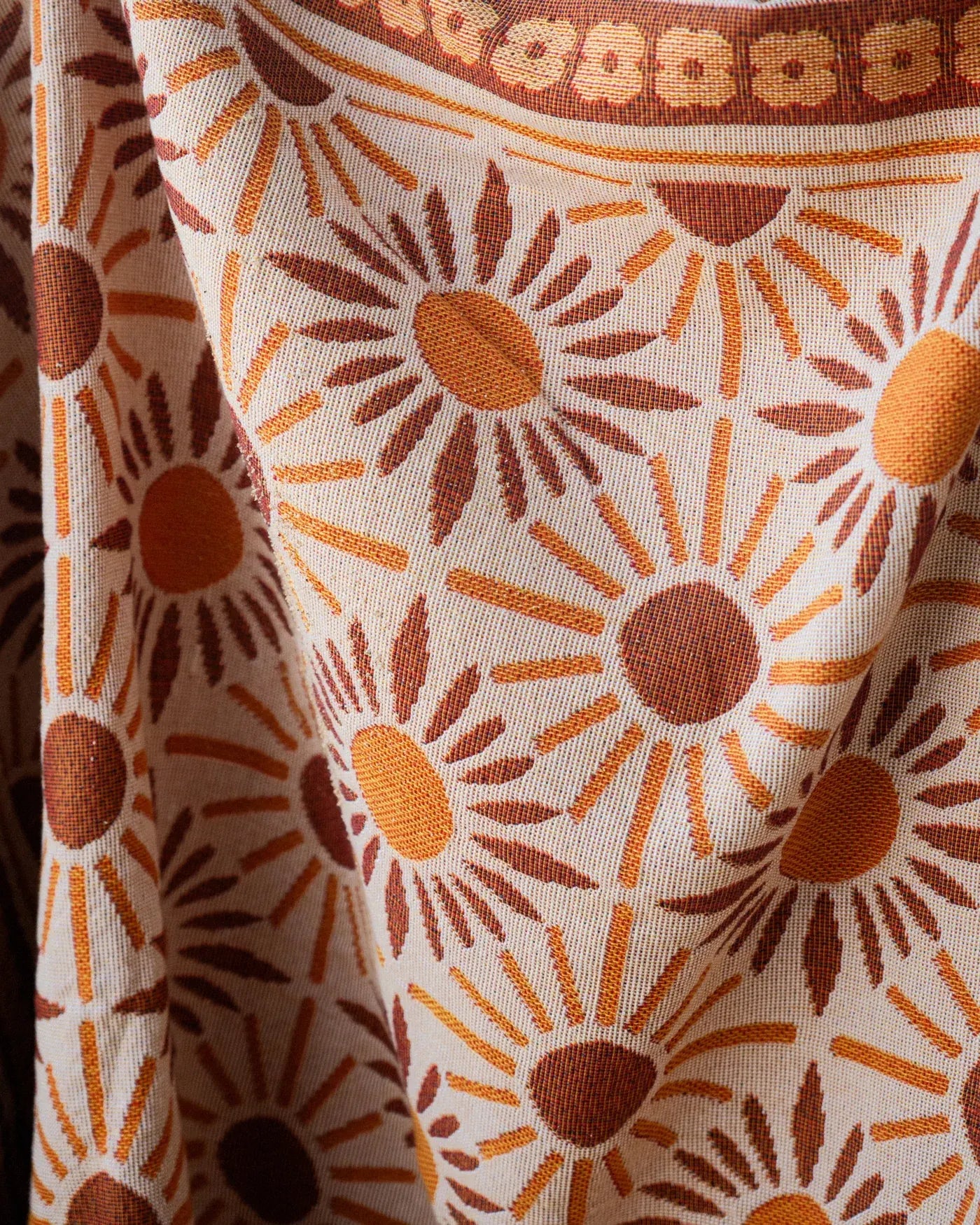
Woven. The jacquard design is crafted directly into the fabric rather than printed onto it, which gives subtle texture, lasting colour and a pattern that wears beautifully over time. Because the design is structural, it wears with the cloth instead of off it.
Is a Turkish towel a good beach towel?
Ours are made for it, along with travel and everyday bath rituals. The practical case is bulk and drying rather than plushness: the cloth is compact and lightweight, and it dries quickly after use, which counts for more in a beach bag than depth of pile does. The Turkish Beach Towels collection is where those pieces sit.
More from the journal.
 bedding
 alpaca
 Alpaca Wool